I've had a few conversations recently whilst walking up the Welcombe Hills. Usually they start with the weather: 'isn't it cold?', 'isn't it lovely?', 'what's the forecast for tomorrow?' Sometimes it's topical subjects that start with, 'when will the cattle arrive?'.
Some of us have been discussing the absence of rabbits up the Welcombe. This time of year usually sees the little bunnies out and the older ones venturing further from cover to get to the best new growth. At first light and at dusk there are usually dozens of rabbits grazing.
Not this year it seems. Elsewhere the rabbit population seems to be good so we are wondering what has caused the fall in this one area.
There do seem to be lots of deer about though. One friend saw fallow deer around the badger sets in the woods a couple of weeks ago and I've see the solitary muntjac breaking cover several times. Further proof is the hoof prints left by the deer. These are easy to spot, even amongst the many dog paw prints.
Here's a fun thing to do if you are up the Welcombe over the coming weeks. Try out your tracking skills. This is easy and good fun for children. Firstly help them to find deer prints so they know what they look like and then follow them and see how far they can be tracked.
Places to look are in the woods down from the reservoir area and along paths. The pictures below that I took the other day should be enough to get you started.
As you can see the deer leaves a distinctive print from its hooves. The smallest ones are likely to be muntjac and the larger ones probably fallow deer.
Children should find this fun especially a the prints often go around in circles and get lost on harder ground and more difficult to trace in the grass.
There are a lot of dog paw prints which you can see in the picture to the right. Note the 4 pads and marks left by the nails.
For more advanced trackers why not look out for badger prints? They are there to be found in the woods. One good place to look is in Clopton Field side by the two large oak trees. There is a track going down from the badger set past the oaks and down to the pond. Look carefully and you might get lucky.
Badger prints are distinguished by 5 pads of the toes and claw marks. Here's one I took the other day. More information is easy to get from the internet i.e. here. My pic seems to show just 4 toes but there is another (pinky?) lost in the slushy mud.
The weather pendulum tends to swing widely back and forth between extremes at this time of year. When it's overcast, wet or the northerly wind snaps at your ears and nose it's head down on the walks up the Welcombe Hills for some spoon carving, looking up only to check for obstacles. It seemed as if these days would never end.
Yesterday the pendulum swung the other way and in the shelter of the Clopton Park side of the hills the heat from the sun encouraged many a walker to unzip top and remove hat. As I ambled along the very top of the field parallel to the bridle path I looked up from my whittling to enjoy the bright, warm light. That very same light and warmth brought a beautiful Small Tortoiseshell butterfly to life and it lay on the bare soil, wings extended absorbing the heat. This butterfly would have been from the second brood of last year. These are the first to reappear having hibernated all winter. You may have found these in your shed or greenhouse. It may be this one had found a sheltered place in a hollow tree.
When I prepared to go out yesterday I toyed with the idea of bringing the camera with me in anticipation of what the seasonal change might bring. Below is a picture of a Small Tortoiseshell from last year and I will be with camera from now on.
A number of us regularly look out for bee orchids up the Welcombe Hills. Usually, we look out for the flowers to appear. This is because once the spring growth gets going the leaves can be difficult to spot in amongst the grass. They have also tended to appear singly and not always in the same place making discovery that much more of a challenge.
I was walking up the Hills marvelling at the lushness of the grass which the weather hasn't told to take a winter rest. Here and there plants were starting to show and then, eyes glued to the ground, I came across a patch of bee orchid plants. They are quite distinctive with pointed finger-like leaves growing out laterally from a tight rosette in the centre. I counted 7 of these in one small area. I find that when you 'get your eye in' it becomes easier to spot things and judging by the number of other bee orchid plants I subsequently came across this year could be a good one for them.
How many will actually flower is another matter. Those with 2 and 4 feet will no doubt play their part in deciding which plants make it to flower. Bee orchids are common in England but not so common up the Welcombe. This adds to the pleasure of finding them in flower.
I came across a blog link from a group mapping the orchids in their area. It might be fun to create a map of where these bee orchids are coming through up the Welcombe and then we can see just how many make it to flower. Here is some more information abut the bee orchid.
As well as the bee orchids which flower in June/July, look out for cowslips all over the hills and especially on the slopes that catch the sun and near bushes. The last few years have been good for them.
This morning we decided the Rowley Fields were just too muddy and headed straight for Clopton Park. It was mild and the sun even broke through. The grass was lush. The Blue Legs (Lepista Saeva - Field Blewit) have gone to mush but surprisingly there are still some Wax Caps about and even some fresh Meadow Wax Caps protruding through the grass. In the distance the sound of woodpeckers drumming in the tree tops made me think it was spring. If I'd seen a swallow I wouldn't have been surprised.
We made our way up the slope towards the Cedar that sits half way up. We go that way often to look for signs that the Tawny Owl has been there - the spattering of white down the tree trunk and the tell-tale pellets on the ground. We were here a few days ago with a friend and I wanted to show her a particular fungus that grows under cedars - Sepultaria sumneriana. I hadn't looked for this cup fungus for a few years and assumed it would still be there but when we looked there was no sign of it. Today I wasn't really looking for it but the cream of the interior of the fungus stood out amongst the green grass and there were several fine specimens.
Sometimes people send me pictures of fungi wanting to know its name. Knowing where the fungus was found and what it was growing on or near are crucial things to know. In the case of this fungus, knowing that it grew under cedar narrows it down to a single species. My field guide says 'season winter to late spring'. So the picture, the habitat and the time of year just about nails it.
Yes, we know the weather is unseasonal but to see violets in December must be unusual. I saw just a couple of these today in the woods overlooking the Welcombe Hotel.
I'm wondering what the effect of this prolonged mild spell will be. I suspect there will be winners and losers as is usually the case. It can't be bad for the birds, but the wet weather won't be good fro small mammals and as a consequence those that feed on them. Plants that bud may have those buds taken by the surely inevitable frost.
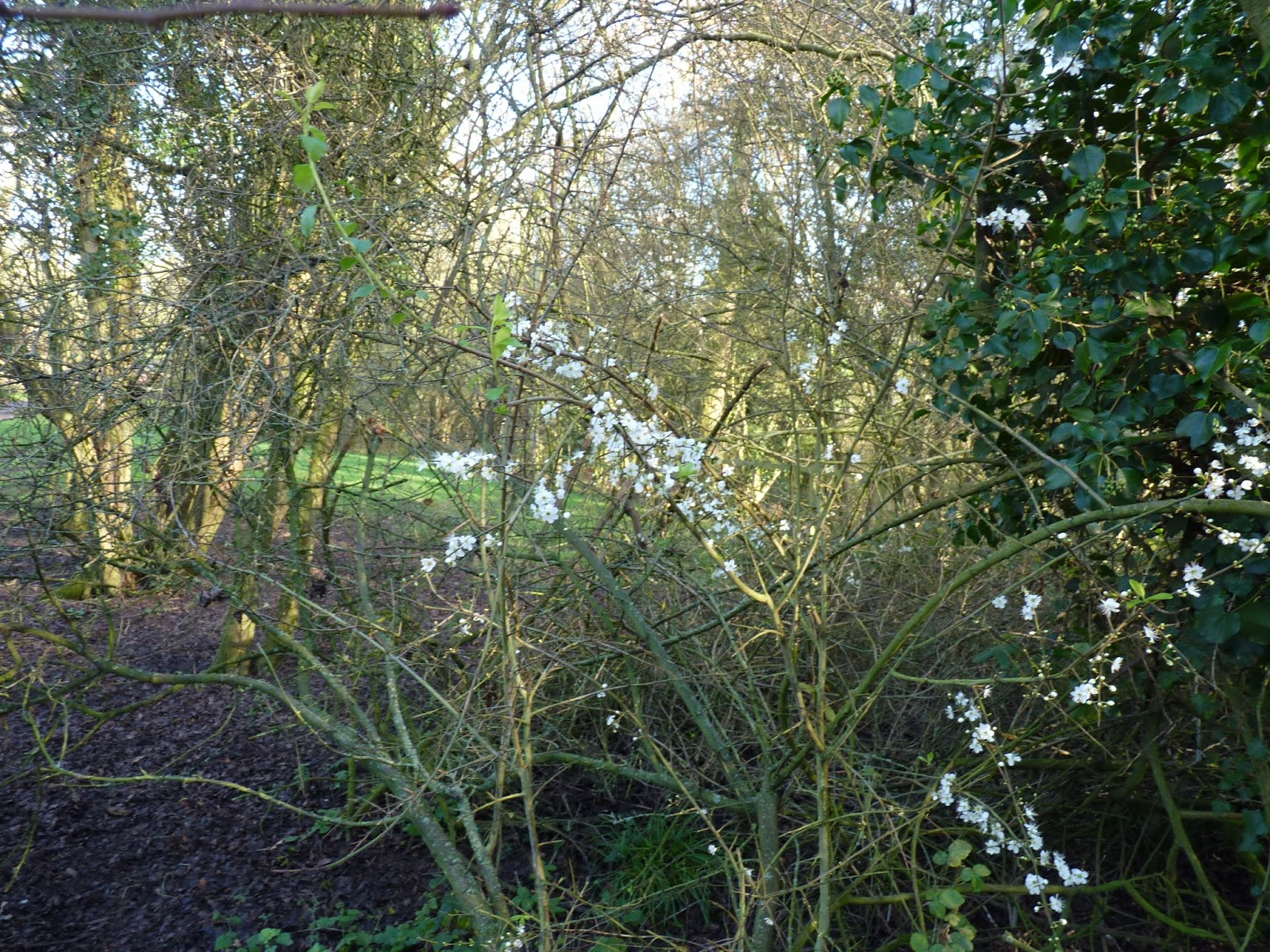
It has been unusually warm so far this winter. The grass is a lush green and still growing and some of the spring buds are showing early. I was a little surprised to come across these sprigs of Blackthorn flower this morning though.
Outside it's cold, wet and it will inevitably be very muddy up the Welcombe. The dogs won't mind though so regardless of the weather we'll be about up there before too long. I was looking through pics on my computer, as I do from time to time, and came across some I took one summer of a family flying kites on the Monument Field. Running in a field, catching the wind with your kite - how good is that?

Here's another pic I took of the grasses and flowers on the Clopton Park side in the summer. It seems to me the Welcombe Hills has got so much to offer so many people.
 The rain's pattering on the conservatory roof, the dogs are getting restless for a walk and I'm thinking about how many layers I'll need to keep warm and dry. I'm also wondering at the incredible seasonal transformations of our countryside. Whilst it won't be a great deal of fun up there in the rain today, it won't be long before spring, the longer days and colour returns.
To be sure, I'll be up there and posting regularly.